The questions below come straight from the calls and texts our dispatchers field every day from customers across Metro Detroit. They are written to help you make a good decision before you hire any air duct cleaning company — not just us.
How BH Air Duct Cleaning Metro Detroit handles air duct cleaning articles work across Metro Detroit
Every job follows the same simple sequence regardless of where in Metro Detroit it sits on the map. You call or text us — usually with a photo of the furnace area if you can manage it — and a real dispatcher (not a call center, not a bot) gathers the basics: address, how many furnace systems, approximate home size, what problem you are trying to solve, and urgency. From there we schedule a crew, give you a real arrival window, a flat-rate quote, and a technician name. There is no "up to" pricing, no dummy ranges, and no "the tech will price it when he gets there" — those are the tells of lead-generation operations that flip your job to the lowest bidder and make the difference up in your basement.
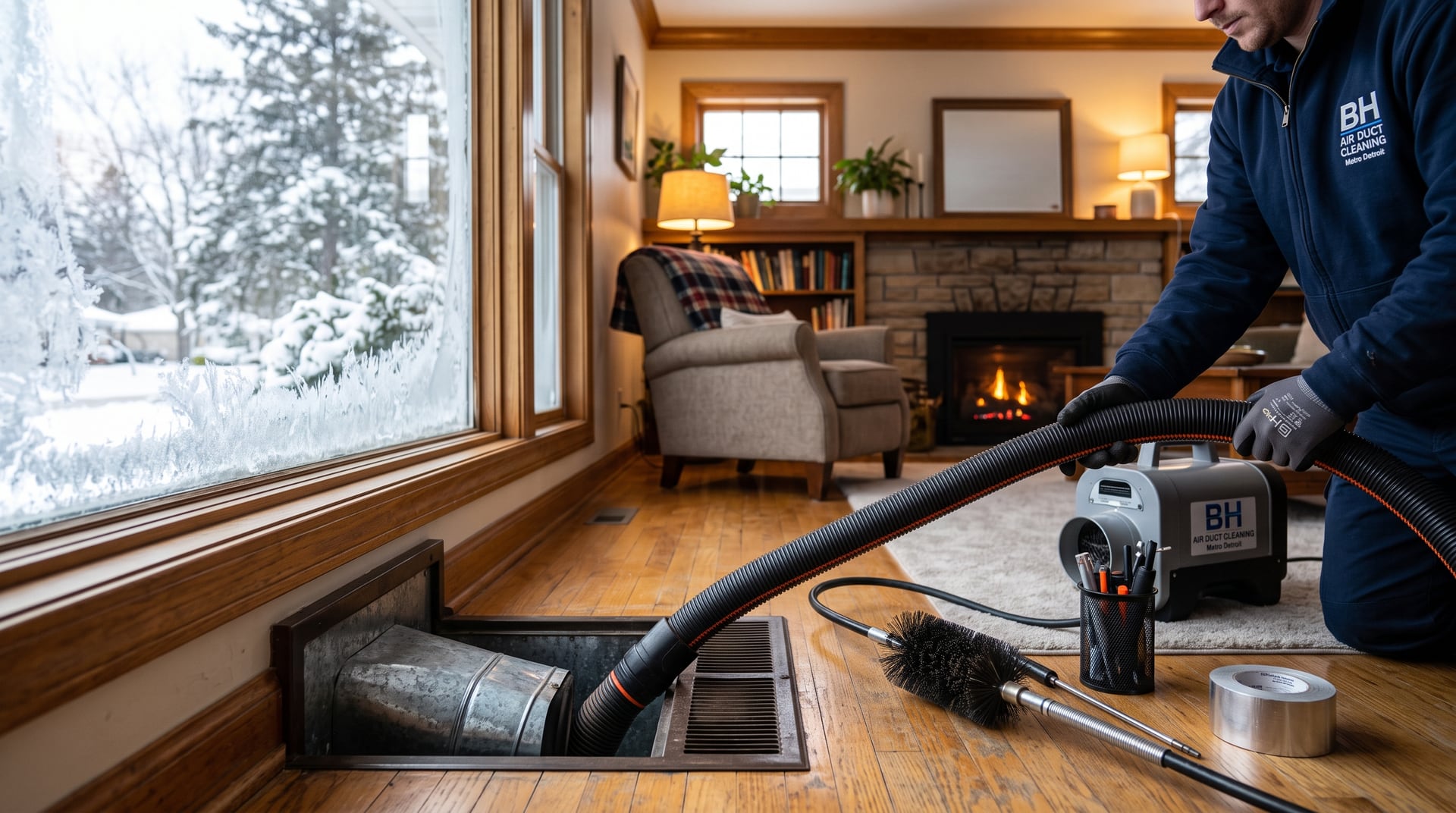
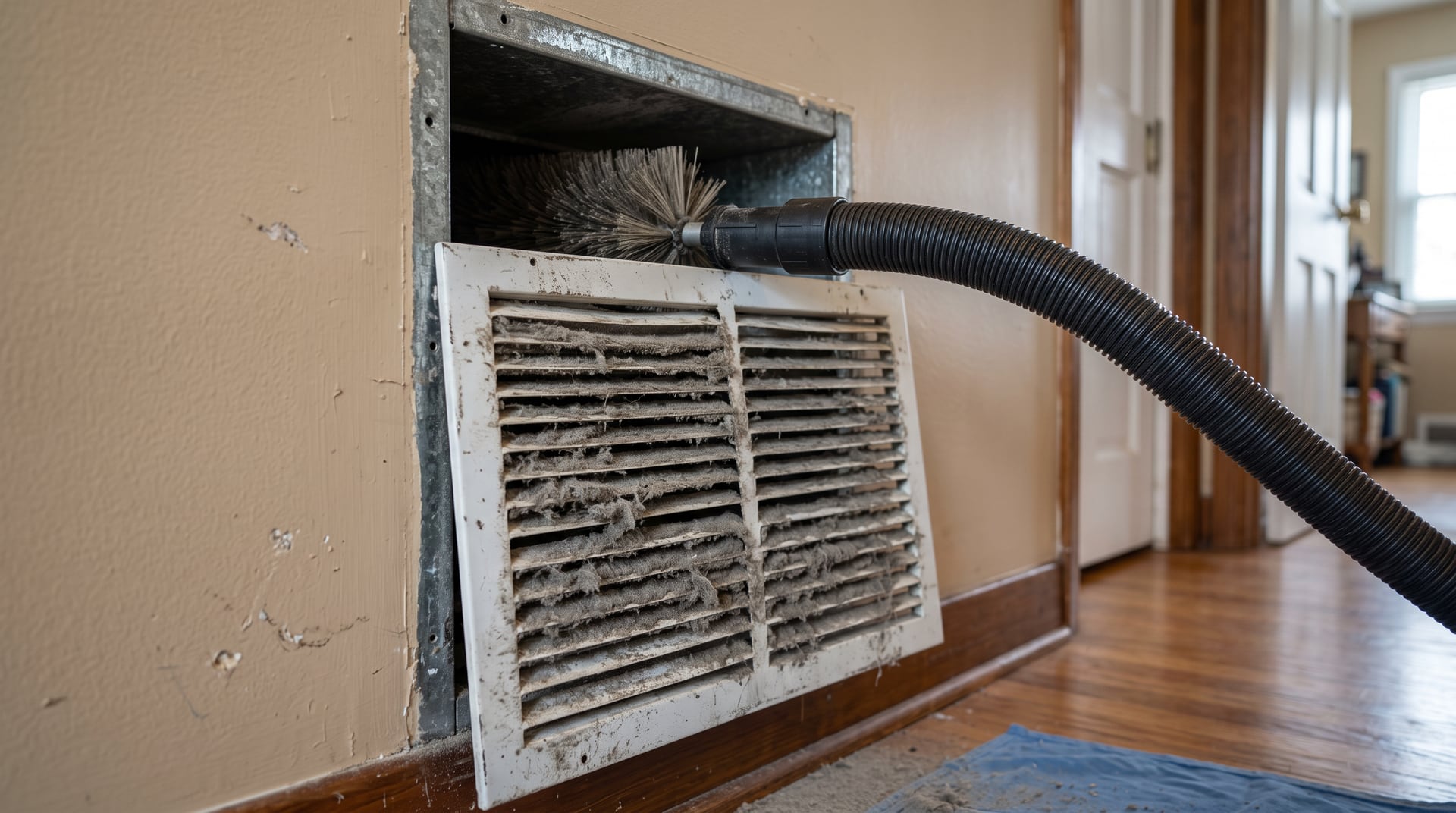
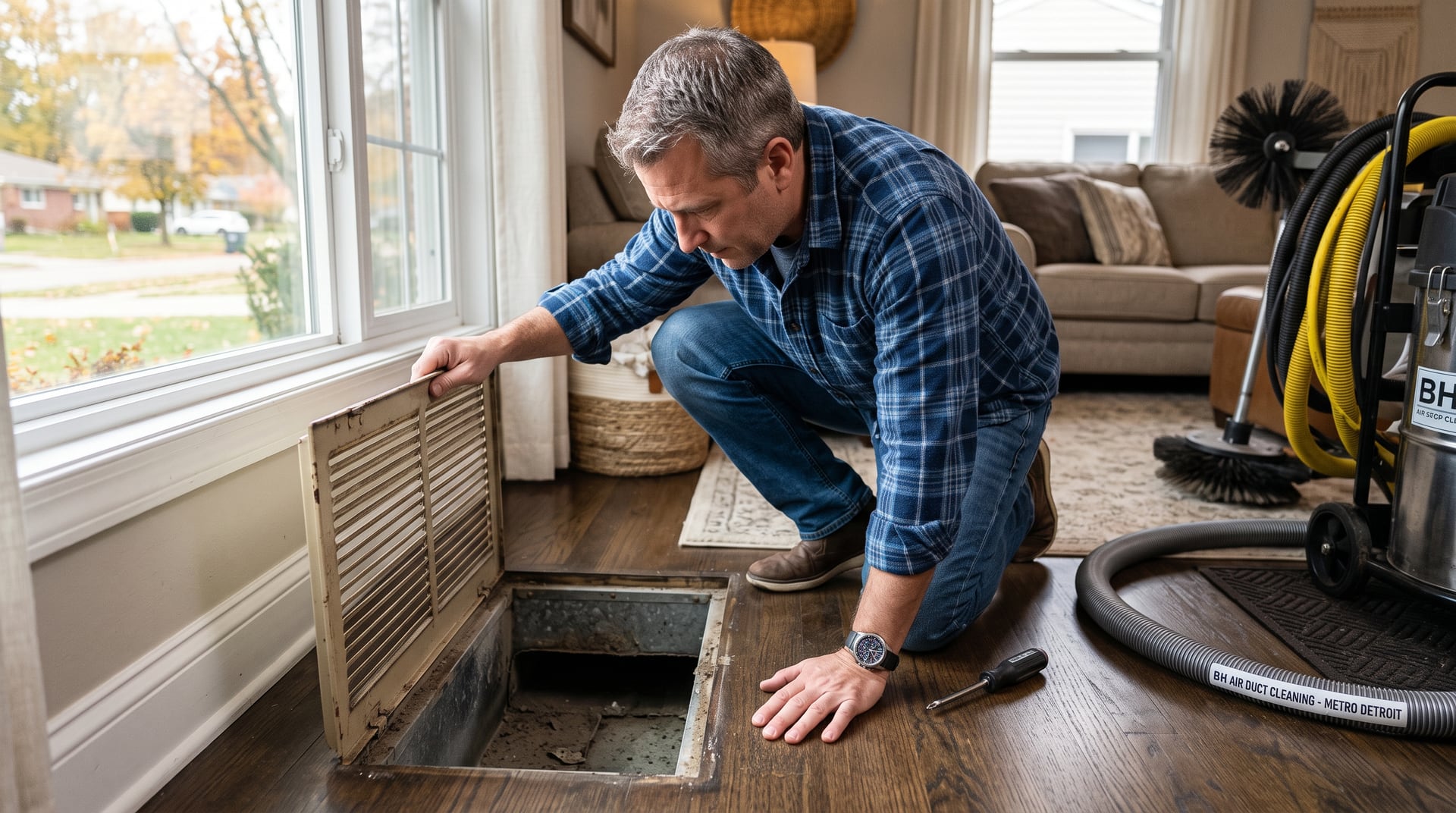
On arrival the crew walks the system with you first — furnace, supply and return trunks, register count, and the dryer vent run if you booked that too — and confirms the written quote a second time before any equipment comes off the truck. Then the vacuum connects to the main trunk near the furnace and the whole system goes under negative pressure. Every supply run and every return run gets agitated with compressed-air whips and rotating brushes, working from the registers back toward the vacuum so dislodged debris travels into the collection system, not into your rooms. Registers come off, get wiped down, and go back on. The job ends with camera or photo documentation of the trunk lines so you can see — not take on faith — what changed.
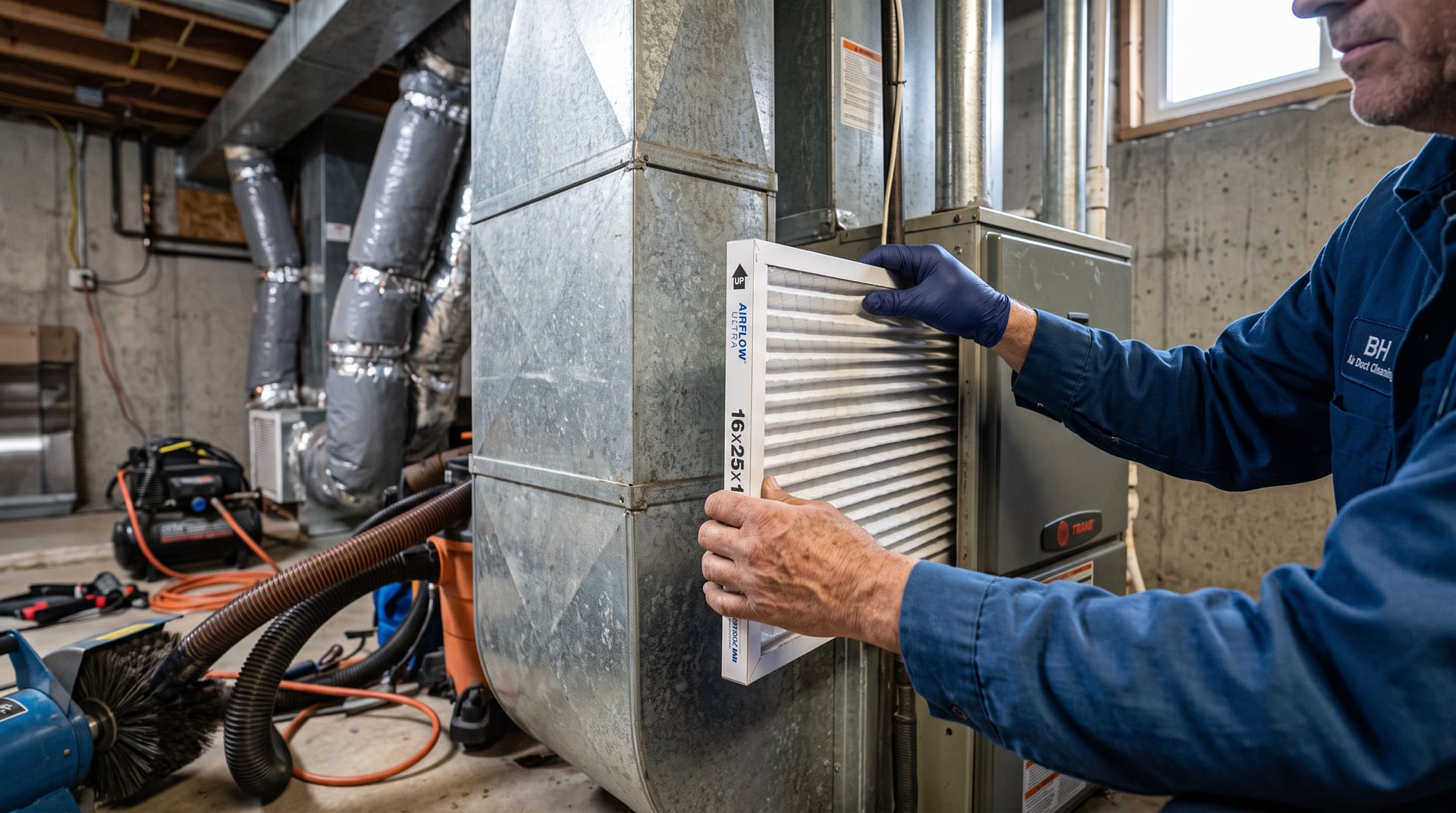
Furnace and coil cleaning follows a longer checklist because it touches the equipment itself: blower assembly access, careful cleaning of the blower wheel (where caked dust measurably cuts airflow), the blower compartment, and the evaporator coil above the furnace. A duct system feeding a filthy blower is like a clean straw attached to a clogged pump — which is why, when a customer's complaint is weak airflow or rooms that never warm up, we quote the blower and coil alongside the ducts rather than selling half a fix. Sanitizing, when a job calls for it, is always the last step and only after physical cleaning: an EPA-registered antimicrobial applied to clean surfaces, never fogged over dirt as a substitute for actual work.
Dryer vent work in Metro Detroit deserves its own explanation because the stakes are different — this is fire prevention, not just efficiency. The lint screen inside your dryer catches only a fraction of the lint; the rest accumulates in the vent duct between the machine and the outside wall or roof. We clean the full run with rotary brushes sized to the duct, verify airflow at the exterior termination, and check the cap and damper for bird nests and lint mats. Long runs — second-floor laundry rooms and condos where the vent snakes 20–40 feet through the structure — are exactly where restrictions build fastest and where a home brush kit cannot reach. If we find crushed foil transition duct or the old white vinyl (a genuine fire hazard), we tell you and can replace it with the correct rigid metal.
Commercial work deserves its own paragraph because downtime and liability are money. A restaurant with a failing makeup-air balance, a medical suite that needs documented cleaning, a daycare with dust complaints, or a condo association staring at a building full of twenty-year-old shared dryer stacks — these are scheduling problems as much as cleaning problems, and we work after hours where operations require it. For facilities and multi-unit buildings we offer planned-maintenance agreements: scheduled cleanings and camera inspections on a fixed cadence, with per-unit records so every visit starts where the last one ended. The property managers who set these up stop fielding tenant air-quality complaints almost entirely, which is the point.
Pricing across Metro Detroit follows the same flat-rate structure regardless of city or neighborhood. Whole-home duct cleaning for a single-furnace home runs $350–$600 depending on size and vent count; a second furnace or system adds $150–$250. Dryer vent cleaning is $120–$200 standalone and discounted when bundled. Sanitizing adds $75–$150 when the job genuinely calls for it. The ~$99 inspection call is credited toward any work you book. Every quote is flat-rate and in writing before work starts. If the scope changes for any reason between the phone quote and the work — a second furnace nobody mentioned, a crushed duct that needs repair — we tell you before doing anything, and you can decline.
A note on the "$99 whole house" ads, because they are the part of this trade with real stakes for your wallet. No legitimate company can put a two-person crew and a negative-pressure vacuum in your home for three hours at that price. The teaser exists to get a salesman into your basement, where ordinary dust becomes "toxic mold" and the $99 becomes $1,500 under pressure. The Federal Trade Commission and consumer-protection agencies have documented this pattern for years. Our advice is simple whether or not you hire us: get the scope in writing, ask what vacuum they use and where it connects, ask to see before-and-after footage of your own ducts, and treat any on-the-spot mold diagnosis delivered without lab work or photos as the sales tactic it almost always is.
Finally, a note on how to compare quotes. A legitimate duct cleaning quote includes the company name, the number of systems covered, whether supply and return sides are both included, whether the blower and coil are in scope, the warranty terms, and a flat total. If an ad shows you a number under $100 for a whole house and the technician starts diagnosing contamination within minutes of arriving, that is the textbook duct cleaning scam pattern. Send the crew away, call us, and we will give you a real second opinion at no cost. We do this several times a week. It is one of the genuinely useful things a real duct cleaning company can do for Metro Detroit, and we are happy to do it whether or not you end up hiring us.
A few practical notes worth knowing before you call any duct cleaning company in Metro Detroit. Check your furnace filter monthly during the heating season and change it on schedule — a good filter is the single cheapest thing keeping your ducts clean between professional cleanings. Watch your dryer: if loads start taking more than one cycle, stop running it unattended and get the vent cleaned, because long dry times are the earliest warning of a lint restriction. And after any renovation involving drywall or sanding, plan on a duct cleaning before you judge the dust situation — construction silica settles into ductwork and recirculates for months. Those three habits prevent the majority of the urgent calls we run.
For homeowners, treat the duct system as part of your home's health envelope. Keep supply registers unblocked by rugs and furniture, keep basement return runs sealed at the joints (leaky returns pull basement air — and basement smells — into your living space), and if anyone in the house has allergies or asthma, invest in the best filter your blower can handle before investing in anything else. In this climate, where the furnace runs six-plus months a year, small duct problems show up on your furniture, your sleep, and your gas bill faster than almost anywhere in the country.
For small business owners, the analog is a documented maintenance plan. Even a one-page log that lists each rooftop unit or furnace, its filter size and change schedule, and the last duct and coil cleaning date will save you real money the first time an air-quality complaint or an overheating unit lands on your desk. A real duct cleaning company will help you write this for free during the first service visit. We do this all the time across Metro Detroit. The facilities that plan this once never have to think about it again; the ones that do not end up calling us the week a tenant, an inspector, or an insurance adjuster starts asking questions.
A quick history of forced-air heating in Southeast Michigan
Metro Detroit is, in a real sense, forced-air country. The post-war housing booms that built Warren, Livonia, Sterling Heights, and the rest of the suburbs installed gas forced-air furnaces and sheet-metal ductwork as the default in nearly every house, decades before much of the country converted from boilers and radiators. The result today is one of the densest concentrations of ducted homes in America — and one of the widest ranges of duct ages, from 1950s galvanized trunk lines still carrying their original construction dust to this year's sealed and insulated flex runs. When we open up a duct system in an older Detroit or Dearborn neighborhood, we are sometimes the first people to see inside it in sixty years.
That range matters for homeowners because the trade has changed underneath the ductwork. Filtration went from loose fiberglass pads that stopped almost nothing to pleated media and electronic air cleaners that genuinely protect the system. Duct sealing went from an afterthought to a measured science, because leaky return runs in basements and crawlspaces quietly pull unconditioned air — and everything in it — into the airstream. And the cleaning industry itself professionalized: NADCA, the National Air Duct Cleaners Association, published the ACR standard that defines what a real cleaning is — source removal under negative pressure, the entire system rather than the visible vents, verified results. If a company cannot tell you what standard it cleans to, it is telling you something.
The dryer vent story has evolved just as fast, and in the wrong direction for safety. As laundry rooms migrated from basements (with a three-foot vent through the rim joist) to second floors and interior condo walls, vent runs stretched to twenty, thirty, forty feet with multiple elbows — every foot and every bend a place for lint to settle. U.S. fire departments respond to thousands of dryer fires a year, and failure to clean is the leading factor. The fix is not exotic: annual cleaning with proper rotary equipment, rigid metal duct instead of foil or vinyl, and an exterior termination that actually opens. It is the least glamorous work we do and arguably the most important.
Michigan's climate is the other constant in this story. Our heating season runs six-plus months, so the blower cycles household dust through the ducts far longer each year than in milder states. Our humid summers condense moisture inside cool basement ductwork, which is where genuine microbial problems start. Our springs fill the air with pollen that a marginal filter passes straight into the system, and our older housing stock — Detroit, Dearborn, the Grosse Pointes, Ferndale — carries decades of accumulated debris in original ductwork. A cleaning cadence that makes sense in Arizona does not transfer here, which is why we recommend every 3–5 years for ducts and annually for dryer vents, adjusted for pets, allergies, renovations, and what the camera actually shows.
For everything we touch, our written policy is the same: clean at the source, document the work with before-and-after footage, apply sanitizer only after physical cleaning and only when the job calls for it, and stand behind the result. The duct cleaning trade has had to earn customer trust the hard way after years of $99 bait operators flooding the search results, and the way we earn it is by doing exactly what we said we would do — on time, in writing, for the agreed price. That standard is portable across Metro Detroit and the rest of Metro Detroit, and it is the reason our guarantee terms are printed on every invoice we send.
One small thing worth saying explicitly: we are a small, local business. The phone number on this page reaches the dispatcher who actually rides with the crews. There is no offshore call center, no national franchise upcharge, no surprise "corporate dispatch fee." That model — a national paid-search operation flipping calls to whichever subcontractor is cheapest that hour — is the reason consumer-protection agencies keep flagging air duct cleaning as one of the most-scammed home service categories in the United States. We have spent years building the alternative: a real shop with real equipment, real employees, and a single phone number that reaches the people who do the work. If you are comparing duct cleaning companies in Metro Detroit on price alone, please at least ask each candidate for proof of insurance, the standard they clean to, and a written flat-rate scope first. The difference between a $99 teaser ad and a written quote with a defined scope is the difference between getting your ducts cleaned and getting your wallet cleaned out.
If you got this far in the page, thank you for reading. Most people will scroll past everything below the call-to-action and grab the phone number, and that is exactly what these pages are for — they exist so the people who do read have a thorough, honest answer to the questions that come up before they pick an air duct cleaning company. We did not write any of this to fill space. It is the answer we would want if we were on the other side of the basement stairs, staring at a stranger's flashlight pointed at our own ductwork, deciding which name on the first page of search results was worth trusting with our home. If something here helped you make a better decision — about us or about any other company — that is the entire point.